The Mars Race: Technical Realism and the Challenge of the Red Planet
Mars exploration has shifted from sci-fi dreams to engineering reality. Discover how robotics and infrastructure are paving the way for human interplanetary life.
Nivagoo
Listen to this article
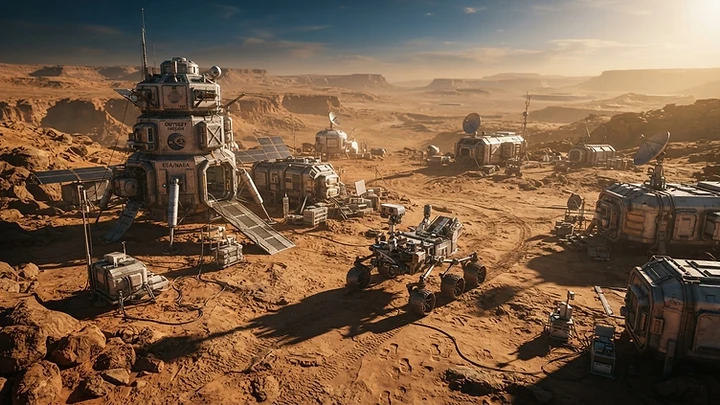
Human exploration of Mars has evolved from a dystopian horizon into one of the greatest engineering hurdles in modern history. What was once discussed as a rapid colonization effort is now viewed by the aerospace industry through the lens of 'technical realism. ' Today, the mission to Mars requires more than just robust propulsion; it demands the consolidation of critical infrastructure in environments where there is zero margin for error.
Reliance on technologies still in development, such as in-situ resource utilization (ISRU), places this objective at the heart of the global debate on technological and scientific sovereignty.
The Reality Check in the New Mars Race
The current landscape is defined by an adjustment of expectations. While public enthusiasm was once fueled by aggressive timelines, physical reality has applied the brakes. As noted by Aerospace America, the development of the Starship system faces complex barriers, from the thermal integrity of ceramic heat shields to the requirement for millimeter-precision landings.
NASA, in turn, has solidified the Artemis program as a mandatory training ground. The strategy is clear: the Moon serves as a laboratory to validate life-support systems and logistics before any interplanetary leap. The technical failure and loss of contact with essential orbiters, as reported by Exame, highlight that the agency's deep-space network operates at critical levels, forcing partnerships with the private sector to ensure mission viability.
Why the Transition to Academic Skepticism Occurred
The divergence between private sector optimism and academic skepticism lies in the physics of payload and return. A technical analysis published in Scientific Reports (Nature) highlights that SpaceX’s payload plans face thermodynamic and mass challenges that, under peer review, lack the viability for a safe return. The actual cost of maintaining life-support infrastructure on Mars vastly exceeds initial marketing estimates, necessitating deep integration between the public and private sectors.
The need for onboard autonomous algorithms, discussed by experts like Ivair Gontijo, is what allows probes and future rovers to operate without constant terrestrial command, which is vital given the communication latencies.
Strategic Shifts in Planning
The focus has shifted from 'who gets there first' to the robustness of infrastructure. The integration of humanoid robots, such as the Optimus project, is emerging as a solution for site preparation and base construction before human arrival. NASA reinforces that operational sustainability depends on space mining and local power generation, avoiding the prohibitive cost of transporting every gram of fuel from Earth.
The current strategy utilizes gravity-assist maneuvers to optimize cargo transport, as seen in recent NASA mission trajectories.
The Global Impact of the Mars Mission Technological development stemming from Mars missions generates cross-sector impacts. Politically, success on Mars is the new benchmark for national sovereignty. Economically, we are witnessing the birth of a space logistics economy, where companies that dominate heavy-lift orbital delivery control the orbital infrastructure market.
Protection against cosmic radiation is another critical point; solutions developed to protect crews will also extend the lifespan of sensitive electronics here on Earth.
Future Trends and the Role of Autonomy
The trend is toward an increasing reliance on artificial intelligence for managing life-support systems. Safety protocols during critical failures no longer depend solely on human redundancy, but on autonomous repair systems. The circular economy, based on the total recycling of resources in extreme environments, will dictate the pace of deep-space exploration.
Opportunities and Risks Opportunities lie in advancements in materials science, high-efficiency solar panels, and robotics.
Conversely, the risks of catastrophic failure in crewed missions and the financial unsustainability of purely commercial projects remain the greatest threats to humanity's progress toward Mars.