
Nvidia and the AI Future: Why the Stock Remains at the Top
Nvidia has become the cornerstone of global AI infrastructure. Explore the market dynamics driving its stock and the structural risks facing the sector.
Nivagoo
Listen to this article
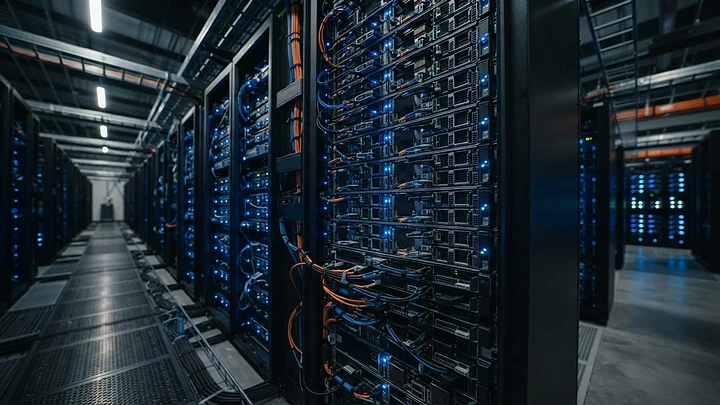
Nvidia has cemented its status as the undeniable engine of the global artificial intelligence infrastructure. With shares reaching historic highs, the market is witnessing a fundamental shift: the company has evolved from a manufacturer of cyclical components into an ecosystem platform anchored by the CUDA framework. This transition allows Nvidia to lock in clients, transforming hardware dependency into long-term technological loyalty, as noted in an analysis by Banco Safra. But to what extent is this euphoria sustainable against current macroeconomic uncertainties?
The Shift from Volume to Value
The semiconductor market is undergoing a paradigm shift. Historically driven by unit volume, the sector is now fueled by Average Selling Price (ASP). While consumer graphics cards were once priced in the hundreds, high-end data center GPUs now command tens of thousands of dollars. According to data from BNP Paribas CIB, growth is not merely coming from selling more units, but from the extreme value captured by each unit due to its technical complexity.
Why Nvidia Has Become a Strategic Bottleneck
Demand for raw computing power has become synonymous with revenue for hyperscalers like Microsoft and Meta. This cycle of dependency, detailed by McKinsey & Company, positions Nvidia as the sole provider capable of sustaining exponential AI growth. Yet, a crucial question arises: what if the Return on Investment (ROI) from AI fails to materialize by 2027? The potential saturation of Capex among tech giants remains the most significant bearish risk. Should infrastructure spending not convert into clear, scalable revenue, Nvidia could face sharp demand adjustments.
The Critical Scarcity of HBM Memory
High Bandwidth Memory (HBM) has emerged as the most critical bottleneck for 2027. According to TechInsights, this shortage will dictate not only Nvidia’s production pace but also which consumer products reach the market. To mitigate this, the industry is accelerating the shift toward chiplet architectures and heterogeneous packaging (CoWoS), techniques that allow for stacking logic and memory with greater energy efficiency, overcoming physical manufacturing limits.
Global Impact: Geopolitics and Sovereignty
The concentration of manufacturing at TSMC, located in the sensitive Taiwan Strait, creates a systemic risk. Any geopolitical instability would paralyze global chip production. Consequently, nations are racing to secure semiconductor sovereignty, investing billions in local fabs to reduce this critical dependency.
Future Trends: From Training to Inference
The market is beginning to shift its focus from exclusive training capabilities to optimizing inference chips. To maintain its dominance, Nvidia must adapt its architecture to handle more agile, real-time workloads. Simultaneously, the environmental impact—with estimates of 197 million tons of CO2e in manufacturing—will force the sector to prioritize extreme energy efficiency in data centers, as reported by SEMI.
Risks and Opportunities
The rise of custom ASICs developed by hyperscalers themselves is a tangible threat to Nvidia's market share. If these internal chips prove sufficiently efficient, reliance on Nvidia may wane. Conversely, companies specializing in thermal infrastructure and data center cooling represent emerging indirect value opportunities in the AI supply chain. Robust quarterly earnings, such as those cited by O Globo, underscore the current boom, yet investors should remain cautious. Note: This article does not constitute financial advice. Asset analysis must consider individual risk profiles.