
The Rare Earths Standoff: Understanding the China-US Fragile Truce
The US-China trade truce over rare earth elements is tenuous. Discover how China's refining monopoly is reshaping global defense and tech security.
Nivagoo
Listen to this article
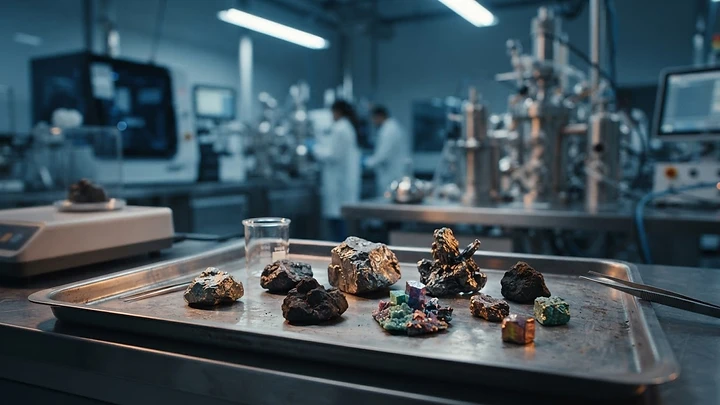
The geopolitics of critical minerals have reached a critical inflection point following the recent trade detente between Beijing and Washington. The market for rare earth elements—vital for the energy transition and the defense industry—has become the epicenter of a geopolitical tug-of-war where China maintains undeniable hegemony. By controlling approximately 85% to 90% of global refining and processing capacity, Beijing effectively utilizes these raw materials as a strategic lever against sanctions imposed by the Trump administration.
The Reality of the Situation
The situation escalated when China began mandating government authorization for the export of strategic minerals, a policy shift detailed by BBC News Brasil. This move directly targeted the American defense sector. Simultaneously, the failure to uphold the so-called 'Busan Agreement'—which previously ensured stable mineral flows—created a supply vacuum, resulting in the selective suspension of exports, as reported by Terra.
Back-channel negotiations involving figures such as Scott Bessent and Chinese scholar Wu Xinbo, highlighted by Valor Econômico, are currently focused on revising the 50% ownership rule, a potential game-changer for foreign direct investment in China.
Why
This Matters: The Refining Bottleneck Over the past few decades, the West effectively outsourced the environmental costs of mining, allowing China to centralize processing. The table below illustrates this technical disparity: | Process | China's Share | Rest of World | | :--- | :--- | :--- | | Extraction | 60% | 40% | | Refining/Separation | 90% | 10% | | Magnet Production | 92% | 8% | The cost of replacing Chinese refining is not merely financial; it is an engineering bottleneck. As Folha de S.Paulo notes, the defense industry, which relies on components for F-35 fighter jets, faces critical delays, forcing startups to pivot toward alternative designs.
Shifts in Mineral Sovereignty
The realization that supply chain dependence is a national security vulnerability has become a consensus view. However, chemical substitution is notoriously difficult. Neodymium-Iron-Boron (NdFeB) permanent magnets are hard to replicate with comparable energy density.
Alternatives like ferrite magnets are cheaper but significantly less powerful, requiring cumbersome redesigns for electric vehicle motors.
Global Impact and Brazil’s Role While the US and China negotiate, Europe is suffering severe collateral damage, with factories facing shutdowns due to market uncertainty, as pointed out by Bloomberg Línea. Brazil, as analyzed by CNPq, holds significant reserves but must balance technical development with geopolitical pressure to avoid becoming merely a battleground for raw materials.
Risks and Opportunities
The immediate risk is technological inflation; if the truce fails, the cost of electronic components will climb exponentially. The opportunity lies in investing in ethical mining outside of China and in magnet recycling technologies, which hold the potential to recover up to 30% of critical minerals already in the industrial cycle.