Fiber Optics: Brazil’s Digital Infrastructure Revolution
Brazil has emerged as a global leader in fiber-optic broadband. Discover how this infrastructure boom is reshaping the nation's digital economy.
Nivagoo
Listen to this article
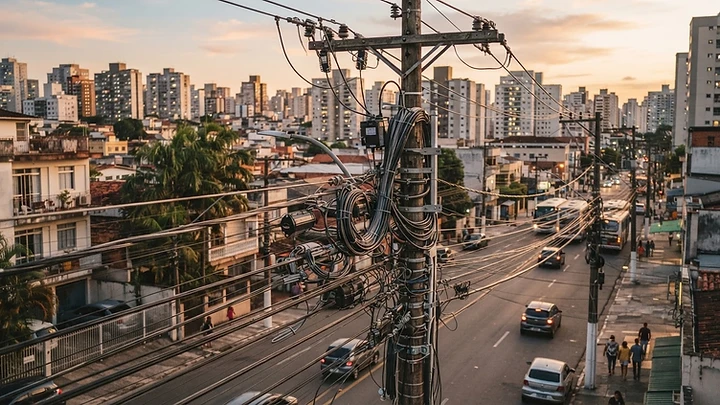
Brazil has established itself as a powerhouse of digital connectivity, currently ranking as the world's third-largest market for fiber-to-the-home (FTTH) broadband, outpacing most European nations. The rapid adoption of this technology is not just a statistical milestone; it is the bedrock supporting the country's digitalization, from residential streaming to the complex demands of Industry 4.0. However, this progress faces strategic hurdles, such as rising input costs and physical infrastructure constraints.
The Shift: Fiber as the New Standard
Fiber-optic infrastructure has evolved from a luxury promise into the dominant technology, powering over 80% of Brazilian fixed broadband connections. According to data from Claro's 'Próximo Nível' portal, the country has climbed global rankings at a breakneck pace. Yet, this aggressive urban expansion contrasts sharply with the interior's reality: as of 2024, over a thousand municipalities still lacked adequate fiber backhaul, revealing a deep geographical disparity that private investment struggles to bridge without robust public policy.
The Drivers: From Data Demand to Investment Urgency
The mass migration to fiber was triggered by the obsolescence of aging copper networks, which could no longer support the surge in cloud computing, telemedicine, and streaming services. Operators shifted their investment strategies to prioritize operational efficiency. Neutral host network models, such as those implemented by V.tal as reported by Valor Econômico, have allowed carriers to reduce CAPEX by sharing infrastructure, enabling faster network expansion rather than duplicating assets in already saturated regions.
Evolution: Connectivity as a Service Platform
Connectivity has shifted from a basic access product to a managed services platform. Fiber infrastructure now acts as the backbone essential for enabling 5G and the Internet of Things (IoT). As highlighted by Teletime, the telecom market is undergoing a transition where raw bandwidth becomes a commodity, forcing ISPs to add value through integrated cybersecurity solutions and cloud computing services.
Global Impact of Brazil’s Fiber Expansion
Brazil has positioned itself as a success story for the neutral network model in emerging markets. The scale of the Brazilian network serves as a benchmark for other nations attempting to provide universal access across vast territories. The technical maturity achieved here is attracting global investors keen on data infrastructure and edge computing, reaffirming Brazil’s importance in the international digital economy.
Future Trends and Projections
Future trends point toward the convergence of fiber networks and the ultra-low latency requirements of 5G. The transformation of Points of Presence (PoPs) into edge data centers is the next logical step to bring processing power closer to the end user. Furthermore, Agriculture 4.0 in the Midwest region depends heavily on rural fiber expansion to ensure that sensors and autonomous machinery operate efficiently, closing the technological gap identified by BNDES as a major barrier to the sector's growth.
Opportunities in Digital Infrastructure
The interiorization of the network opens vast opportunities for tech companies. Beyond agribusiness, the digitalization of public services in smaller cities allows for the implementation of genuine 'smart cities,' optimizing everything from urban traffic to water resource management. Local providers, as they scale, are becoming regional economic engines, offering enterprise-grade connections in areas where services were previously inadequate.
Risks on the Connectivity Horizon
The sector faces critical challenges. The bottleneck of pole sharing, discussed by Hardware.com.br, has put telecom operators and energy utility companies at odds. Currently, there is no unified long-term governance to resolve pole saturation. Additionally, the impact of antidumping tariffs on imported optical cables remains a concern. While domestic manufacturers seek protection, industry entities like TelComp and Abramulti warn that cost increases of up to 50% could slow expansion in low-income areas, making the goal of universal education access even more costly and distant.
Sources and references
- Teletime — "Artigo Mercado Telecom Curva"
- Hardware — "Fibra Optica Disputa Espaco Postes Brasil"
- Ipnews — "Tarifa Antidumping Pode Disparar Preco Da Fibra Optica Importada E Impactar A Expansao Da"
- Bndes — "20180"
- G1 — "Rede Neutra De Fibra Optica Acelera A Expansao Da Conectividade.ghtml"
- Claro — "Fibra Optica Tornou A Conectividade Uma Commodity"